9
The German national team concluded its 2026 international calendar with two impressive UEFA Nations League victories, securing passage to the quarter-finals as group winners and supplying supporters with considerably more reasons for optimism than seemed possible during Jürgen Klopp’s first assignments as Bundestrainer. Germany once again find themselves in the ascendancy.
Well then. What a difference a month makes!
A convincing 3-1 victory over Serbia in Belgrade on Friday preceded an extraordinary 5-0 dismantling of the Netherlands in Berlin on Monday. Eight goals, six points, and first place in Group A2. The results alone would have sufficed to declare November a success. The manner in which Germany accomplished all of this, however, offers far more interesting material for analysis.
The contrast with September is particularly striking. Get German Football News spent much of Klopp’s first international window documenting the considerable difficulties encountered during his experimental 44-player squad selection. An uninspiring 1-1 draw against the Netherlands and a frustrating 1-0 home defeat to Greece left many questions unanswered.
Germany gradually improved during the October assignments. Klopp’s first victory over Serbia finally offered tangible evidence of the collective intensity and positional flexibility he wanted to establish. The subsequent scoreless draw in Greece nevertheless made evident that there remained plenty of work to do.
November supplied considerably stronger evidence of progress.
Against Serbia, Germany controlled 79 percent of possession, attempted 22 shots, and generated 3.57 expected goals according to Opta match data. The overmatched hosts rarely managed to disrupt Germany’s midfield rhythm during the opening 45 minutes, while the visitors created enough opportunities to have settled the encounter well before the interval.
The Netherlands presented a considerably more demanding assignment. Xavi Hernandez’s side arrived in Berlin having scored seven goals against Greece and needed to be beaten if Germany were to guarantee progression.
It took some time for the Germans to gain control of the contest. The Dutch created several dangerous transition situations early on, and Germany’s aggressive positioning occasionally left the defensive line exposed. By the conclusion of the match, however, the visitors had been completely overwhelmed.
Perhaps even more significantly, Klopp appeared to have settled upon a more consistent tactical structure.
Having experimented with several formations during his opening assignments, the Bundestrainer deployed the same basic 4-1-4-1 in both November matches. The arrangement placed Joshua Kimmich at the base of midfield, with Aleksandar Pavlovic and Florian Wirtz operating further forward. Brajan Gruda and Derry Scherhant supplied the wide attacking threat, while Kai Havertz led the line.
The personnel changed little between Belgrade and Berlin. The results, however, provided further confirmation that Germany’s emerging system can accommodate both established internationals and the players Klopp has introduced.
We now turn to the seven footballers who benefited most from this remarkable conclusion to the 2026 international calendar.
The Seven Winners
As usual, the selections appear in descending order from strongest to weakest. Goals and assists obviously count for plenty, but so too do tactical contributions, consistency, and the extent to which individual players have taken advantage of the opportunities afforded them.
Some of the choices are rather straightforward. Others require a broader assessment of the player’s place in Klopp’s squad hierarchy. A footballer need not deliver two spectacular performances to emerge from an international break in a stronger position than the one he occupied beforehand.
The author shall endeavor to defend all seven selections.
Brajan Gruda, RB Leipzig
One suspects that even the most optimistic observers of Gruda’s development could scarcely have envisioned a more productive first two senior international appearances. The 22-year-old arrived in November as one of the few remaining uncapped members of Klopp’s original Germany selection. Injury had deprived him of his first opportunity during the previous international window, despite the Bundestrainer having already identified him as a player of considerable interest.
As GGFN reported following Gruda’s impressive Champions League performance against PSV Eindhoven in October, Klopp had personally encouraged the youngster to remain patient, assuring him that a postponed debut did not necessarily mean a cancelled opportunity. That opportunity arrived in Belgrade, where Gruda immediately demonstrated the qualities that prompted Klopp to include him.
Operating on the right wing, the Leipzig attacker mixed direct running and technically ambitious dribbling with the occasional ill-advised attempt to beat too many opponents. Some questionable decisions and a deserved yellow card reflected the understandable exuberance of a player making his international debut.
The early signs were nevertheless encouraging. Gruda’s excellent delivery from the right in the 19th minute should have provided Havertz with a goal, although the Arsenal striker failed to connect properly with the cross. The youngster’s defining contribution arrived five minutes after the restart.
Released by Kimmich from deep in Germany’s half, Gruda embarked on a sensational solo run across approximately half the pitch before finishing past Vanja Milinkovic-Savic. Serbian defenders offered rather limited resistance along the way, but there could be no disputing the ambition and execution of the individual effort.
Gruda’s first international goal effectively secured Germany’s victory. The Leipzig professional saved his finest overall performance for Berlin. Once again deployed on the right, Gruda repeatedly attacked his opponents in one-on-one situations. His first-half work wasn’t entirely free of inaccuracies, but the second 45 brought a spectacular combination of invention and productivity.
An excellent diagonal pass from Schlotterbeck presented Gruda with another opportunity to cut inside and shoot shortly after the restart. The winger continued searching for openings before taking over as one of Germany’s principal creative forces.
Gruda delivered the free kick from which Schlotterbeck headed Germany’s third goal, supplied Wirtz with an excellent opportunity to score the fourth, and completed the scoring himself after Scherhant’s effort rebounded off the post.
One goal and two assists against the Netherlands. Two goals and two assists across his first two senior internationals.
The numbers are impressive enough. More significantly, however, Gruda appears particularly well suited to the type of football Klopp wants Germany to play.
Florian Wirtz, Liverpool
Wirtz entered November in a somewhat different position from Gruda. The Liverpool playmaker had already established himself as one of Germany’s most influential performers under Klopp, even if his difficult adjustment to English football continued to attract considerable scrutiny.
GGFN previously examined whether Wirtz could translate his increasingly impressive Germany performances into greater success at Liverpool. That question remains pertinent, but his progress at international level has become difficult to dispute.
Indeed, the most important development may be the clarity with which Klopp now appears to understand how best to deploy him. The 4-1-4-1 used in November positioned him ahead of Kimmich, alongside Pavlovic, and permitted the Liverpool professional to influence Germany’s attacking play between the opposition’s midfield and defensive lines.
Against Serbia, Wirtz constantly involved himself in the short-passing combinations that helped the Germans establish control. His quick reactions and composed finish supplied Germany’s second goal after Kai Havertz’s initial attempt was saved. The Liverpool playmaker was also active in the counterpress, frequently responding to turnovers by immediately attempting to regain possession.
The Netherlands encounter provided an even more emphatic demonstration of his abilities. Wirtz’s first goal in the 60th minute resulted directly from his aggressive work without the ball.
After exchanging passes with Scherhant near the Dutch penalty area, the German attacking midfielder initially lost possession when Denzel Dumfries intervened. Wirtz nevertheless persisted, recovered the ball himself, and manipulated his way into shooting space before dispatching an outstanding left-footed finish into the corner.
Eleven minutes later, he produced another superb attacking contribution. Wirtz initiated the sequence himself by distributing the ball to Gruda on the right. Rather than remaining in his original position, he continued his run toward the penalty area, where Gruda eventually found him with a precise square pass.
The first-time finish beneath the crossbar completed his brace.
Three goals across two matches. Four in total since Klopp assumed responsibility for the national team.
At this stage, one can reasonably argue that the Liverpool professional has become the most important creative reference point in Germany’s emerging attacking system.
Derry Scherhant, Freiburg
What a remarkable month for the Berlin native! Scherhant already numbered among the more successful newcomers from Klopp’s first international window. He retained his place when the Bundestrainer reduced his original selection and entered November hoping to build upon two promising Germany starts.
His display against Serbia was encouraging without being spectacular. Three days later, however, the 24-year-old produced an unforgettable display in his hometown. As Get German Football News documented in its feature on Scherhant’s emotional Berlin homecoming, the former Hertha BSC youngster had arranged approximately 50 tickets for family members and friends ahead of Monday’s encounter.
He certainly gave them their money’s worth.
Scherhant attacked the Dutch defence with pace and conviction from the opening stages, frequently seeking individual duels and attempting to manufacture shooting opportunities. His first major chance came in the 32nd minute, when a delivery from Freiburg teammate Philipp Treu reached him near the edge of the penalty area. Scherhant turned and struck the outside of the post.
Nine minutes later, Kimmich supplied him with possession in a dangerous area. Scherhant cut inside and unleashed a magnificent effort into the upper-right corner. The opening goal set Germany on their way to victory and represented a particularly emotional moment for a player who had spent much of his youth dreaming of becoming a professional footballer in Berlin.
Scherhant nearly added another goal immediately after the restart and subsequently contributed to Germany’s fifth by striking the post before Gruda converted the rebound.
The winger’s rise becomes even more remarkable when placed in the context of his career.
GGFN’s October feature on Scherhant’s unconventional journey to the national team documented the difficulties he encountered at several Berlin clubs before eventually establishing himself at Hertha. His subsequent move to Freiburg has proved especially important.
Scherhant’s excellent technical qualities are now being supplemented by the work rate and defensive commitment Klopp demands from his wide attackers. The Bundestrainer explicitly praised the enormous amount of running and defensive work performed by Scherhant and Gruda against the Netherlands. A player once deemed unlikely to progress beyond the Regionalliga now appears capable of securing a lasting place in the German national team.
That is quite some winner.
Joshua Kimmich, Bayern Munich
The captain’s inclusion may initially appear somewhat peculiar. After all, Kimmich hardly required the November international break to establish himself as one of Germany’s most accomplished footballers. The skipper’s position within Klopp’s emerging midfield structure had become the subject of considerable discussion.
The Bayern midfielder sat out Germany’s October victory over Serbia as the Bundestrainer continued experimenting with younger alternatives. Aleksandar Pavlovic, Tom Bischof, and Florian Wirtz combined particularly well in his absence, immediately prompting questions about whether Germany might function more effectively without their established captain.
Get German Football News examined the debate over Kimmich’s role, noting both Klopp’s desire to experiment and his insistence that the Bayern veteran remained an important part of his plans. November provided a footballing answer. Kimmich returned to the starting XI against Serbia and occupied the solitary holding midfield position in Germany’s 4-1-4-1.
The role suited him rather well.
While Pavlovic advanced into the interior spaces, Kimmich assumed responsibility for distributing possession from deeper positions and maintaining the team’s passing rhythm. The captain supplied several useful forward deliveries during the first half and released Gruda for his spectacular solo goal after the interval. His distribution and positional intelligence contributed significantly to Germany’s control of the match.
An even better performance followed against the Netherlands. Kimmich supplied the opening pass in the sequence that produced Germany’s first meaningful opportunity, repeatedly identified passing lanes into advanced areas, and set up Scherhant’s opening goal. His intelligent distribution continued after the restart, while another pass into Scherhant initiated the sequence that eventually produced Gruda’s fifth goal.
Perhaps the most significant tactical development concerns the relationship between Kimmich and Pavlovic.
The latter had operated as Germany’s principal holding midfielder during the previous international window. November demonstrated that the two Bayern professionals can function effectively together without requiring either to replicate the other’s preferred responsibilities.
The international break established that Kimmich remains more than capable of directing the tempo of Klopp’s Germany from central midfield. The captain will surely appreciate having demonstrated that on the pitch.
Nico Schlotterbeck, Borussia Dortmund
Schlotterbeck’s inclusion among the winners requires a slightly different explanation. Unlike most of the players discussed thus far, the Borussia Dortmund centre-back did not start both matches. Indeed, he spent the entirety of Germany’s victory in Belgrade on the bench.
Klopp preferred Newcastle United defender Malick Thiaw alongside Jonathan Tah against Serbia, reportedly valuing Thiaw’s aerial qualities in a matchup that called for considerable physical presence. Schlotterbeck nevertheless returned to the starting XI against the Netherlands.
His performance justified the decision emphatically. The Dortmund professional established himself as an important part of Germany’s defensive structure from the opening stages. Schlotterbeck’s distribution also added something useful to Germany’s buildup.
The defender’s most important contribution arrived in the 64th minute. With the Netherlands attempting to construct an attack from the back, Schlotterbeck advanced aggressively to pressure the opposition’s buildup. His movement forced the Dutch into difficulties, enabling Scherhant to recover possession and draw a foul.
Gruda delivered the resulting free kick. Schlotterbeck attacked the delivery and guided a precise header into the corner, scoring Germany’s third goal and effectively putting the result beyond doubt. Schlotterbeck’s second goal for country could not have arrived at a better time.
The combination of pressing work and attacking contribution represented an excellent illustration of Klopp’s demands. Schlotterbeck wasn’t finished defensively either. In the 70th minute, the Dortmund man made an important intervention against a dangerous Dumfries delivery, clearing the ball while falling to the ground.
The performance in Berlin offered a powerful argument for restoring Schlotterbeck to a more permanent role alongside Tah. The partnership combined physical reliability with progressive passing, while Schlotterbeck’s willingness to advance into the opposition half suited Germany’s aggressive pressing approach.
Schlotterbeck took emphatic advantage of his opportunity.
Aleksandar Pavlovic, Bayern Munich
Pavlovic turned in two excellent performances. Pavlovic occupied an important position within Germany’s midfield structure during Klopp’s October assignments, most notably when he combined with Tom Bischof and Florian Wirtz during the 2-0 victory over Serbia.
As GGFN documented in its earlier tactical examination of Klopp’s midfield, Pavlovic’s composure in possession and willingness to circulate the ball under pressure helped Germany establish a more coherent attacking structure. The obvious question entering November was how the youngster would adapt to the return of Joshua Kimmich.
The answer proved encouraging. Rather than displacing Pavlovic, Klopp retained the midfielder in his starting XI and adjusted his responsibilities. Kimmich took over as the solitary holding midfielder in the 4-1-4-1, while Pavlovic pushed into the more advanced central midfield line alongside Wirtz.
The arrangement presented an interesting challenge for a footballer more accustomed to functioning as one of the deepest players in his team’s possession structure. Pavlovic nevertheless adapted well.
Against Serbia, the midfielder was particularly effective in helping Germany establish control during the opening half. His most significant attacking contribution came in the 14th minute, when he reacted to a Serbian turnover by releasing Havertz with an excellent forward pass. The Arsenal striker’s initial effort was saved, but Wirtz converted the rebound to give Germany a two-goal advantage.
The pass illustrated Pavlovic’s capacity to influence the attacking game from a more advanced starting position. Pavlovic retained his place against the Netherlands and again operated ahead of his Bayern teammate.
The opening half wasn’t entirely convincing, but the youngster improved considerably after the interval. His passing became more assured, and he contributed more actively to Germany’s increasingly dominant possession phases. Pavlovic also advanced into a shooting position in the 74th minute, forcing Dutch goalkeeper Bart Verbruggen into a save.
The significance of these two appearances lies in the options they provide Klopp. Get German Football News previously examined Pavlovic’s growing importance within Bayern’s midfield, where his established relationship with Kimmich has helped both players develop a strong understanding.
That connection may prove particularly valuable at international level.
Philipp Treu, Freiburg
The final place goes to a footballer who has quietly become one of the most important beneficiaries of Klopp’s willingness to introduce unfamiliar faces into the national team. GGFN examined Treu’s ambitions to establish himself at right-back when he received his first senior nomination in September. At that stage, the Freiburg professional represented an intriguing alternative for a position at which Germany had struggled to establish continuity.
Two months later, Treu has accumulated further international experience and appears increasingly comfortable with the demands placed upon him. The 25-year-old retained his position for both November fixtures. Against Serbia, Treu frequently moved infield from right-back to support Germany’s combinations in central areas. His aggressive defensive approach and willingness to push forward reflected Klopp’s instructions.
The Netherlands match presented considerably greater challenges. Treu was not entirely secure defensively during the opening stages. Cody Gakpo escaped him before delivering a dangerous cross toward Donyell Malen in the 26th minute, demonstrating that the Freiburg man still has areas of his game to refine.
Nevertheless, Treu remained an important attacking outlet. He was continuously available on the right and supplied the delivery from which Scherhant struck the post in the 32nd minute. The move itself offered an excellent example of Germany’s attacking cooperation. Kimmich initiated the sequence from midfield, finding Gruda on the right. The Leipzig attacker moved the ball on to Treu, whose delivery located Scherhant in a dangerous central position.
Treu’s inclusion is therefore not necessarily a reward for two spectacular individual performances. Rather, the Freiburg defender emerges as a winner because of the important position he now occupies in Klopp’s squad hierarchy. The Bundestrainer has continued to trust him, including in an important encounter against the Netherlands, and Treu has responded with disciplined, industrious performances.
DFB Tactics Check
One of the more interesting aspects of Germany’s November international break was the consistency of Klopp’s personnel selections and the more clearly defined structure within which they operated. Having experimented extensively during September and October, the Bundestrainer retained a 4-1-4-1 in both matches, making only two changes to the starting XI between Belgrade and Berlin.
The underlying arrangement was important.
Lineup—Germany vs. Serbia
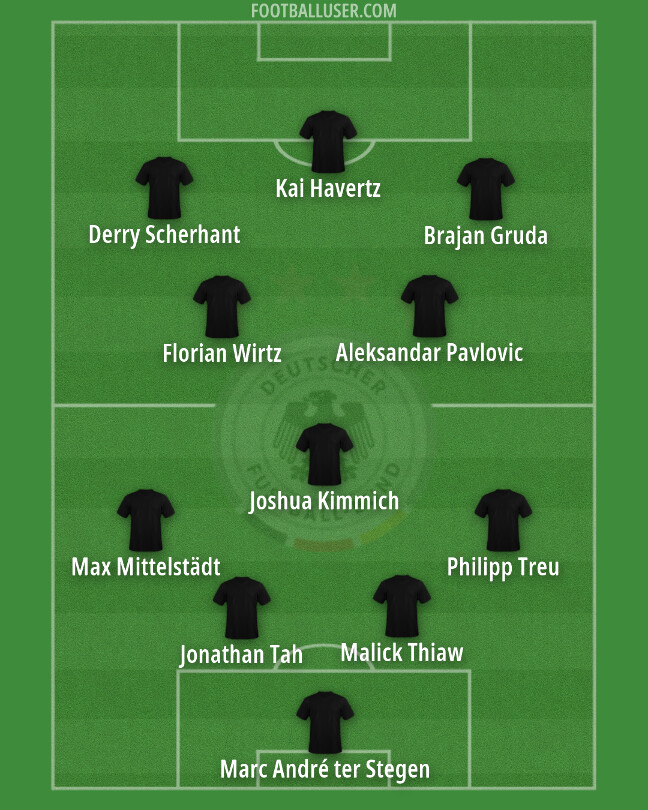
For the Netherlands encounter, Nico Schlotterbeck replaced Thiaw in central defence, while Nathaniel Brown came in for Mittelstädt at left-back.
Lineup—Germany vs. Netherlands
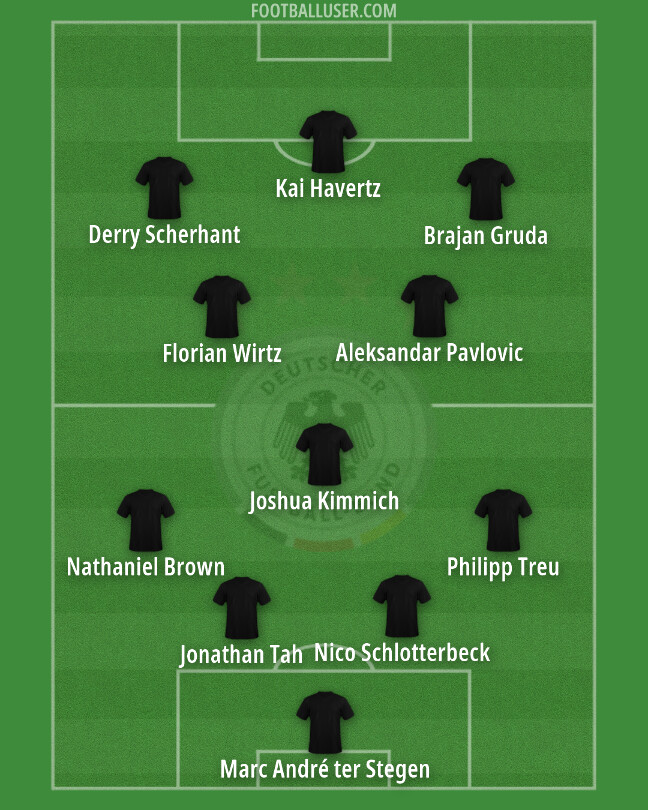
As GGFN established in its examination of Klopp’s opening international assignments, the Bundestrainer’s early experimentation involved different midfield partnerships, variable fullback assignments, and frequent changes in the positioning of the wide attackers. November offered a more settled approach, even if the precise relationships between the players continued to change according to the circumstances of each match.
The advantage of the November midfield arrangement concerned the fact that Germany could retain Kimmich’s distribution while allowing Pavlovic to contribute to attacks from more advanced positions. Wirtz was also afforded considerable freedom to move between the lines and connect with the wide attackers.
Havertz frequently dropped away from the highest position to participate in combinations, opening space for midfield runners and creating opportunities for Gruda and Scherhant to move inside. The shape could consequently change considerably during possession without abandoning the 4-1-4-1 as its starting reference.
What November tells us about Klopp’s Germany
There is no need to declare Germany’s tactical development complete after two victories. The defensive vulnerabilities evident early against the Netherlands and during Serbia’s stronger second-half spells suggest that the national team still has work to do when opponents escape the initial press. Moreover, the competition for positions remains considerable.
Schlotterbeck’s performance has strengthened his claim to a regular place alongside Tah, but Thiaw remains a credible alternative. Pavlovic’s successful adaptation to the advanced midfield role provides another option without diminishing the importance of Bischof and Germany’s other central midfield candidates.
Treu has emerged as a trusted right-back, while Gruda and Scherhant have made powerful arguments for continued selection on the wings. The strongest tactical conclusion concerns the greater coherence of the team’s overall structure. Klopp has moved from experimenting with a remarkably large number of players to establishing a recognizable 4-1-4-1 in which established internationals and emerging talents complement one another.
The high pressing and counterpressing remain important, but the positional relationships in midfield and the improved cooperation between the wide players and fullbacks have given Germany greater attacking variety.
The rewards of that approach were obvious in Berlin. Germany will enter the Nations League quarter-finals next March with renewed confidence, greater tactical clarity, and considerably more competition for places.
The new Bundestrainer has plenty of decisions still to make.
For the first time in quite a while, that feels like a very welcome problem.
GGFN | Peter Weis
About Author

You may also like
-
Bundesliga Fantasy Show: Matchday 10 draft team
-
Germany’s 5-0 demolition of the Netherlands draws impressive television audience
-
Klopp reveals he wanted to bring Germany star to Liverpool
-
Gladbach rule out winter sale of 17-year-old Bayern, Leverkusen, Brighton and Liverpool target
-
Freiburg’s Derry Scherhant celebrates dream Berlin homecoming