0
Tonight’s Get German Football News long-form feature takes an in-depth look at Eintracht Frankfurt on the eve of what promises to be an unprecedented and interesting event. Most sources now confirm that Eintracht Frankfurt have chosen Albert Riera to serve as the team’s next head coach. The Spaniard remains a highly curious selection set to be placed in charge of a highly unstable team. That is, if Frankfurt still decide to hire him.
We’ll first take a look at what precisely sort of team Riera will be inheriting via a tactical review of the last three games Eintracht have contested under the interim trainer regime of Dennis Schmitt and Alexander Meier. After assessing the two Champions League losses against Qarabag and Tottenham, as well as the Bundesliga loss against Hoffenheim, it’s time to ruminate on how foreign coaches have fared in the Bundesliga in recent years.
Riera’s Bundesliga appointment promises to work as a very intriguing experiment in which a coach of little high-level footballing experience and little German linguistic ability gets thrown directly into a rather chaotic fray. Answers to a whole slew of questions about how Riera shall fare will have to wait until he takes his seat on the bench. For the time being, we can only set the stage.
“A Black Night in Baku”
We’ll pick up right where we left off, taking a deeper dive into the tactics of the first match under the current SGE interim coaching regime. Schmitt and Meyer went with three changes to the XI that lined up against Bremen under Toppmöller. Can Uzun, Ansgar Knauff, and Hugo Larsson replaced Arnaud Kalimuendo, Mahmoud Dahoud, and Fares Chaïbi. The previous 4-1-4-1 turned into a 3-4-3.
Kalimuendo unfortunately couldn’t partake as he hasn’t been registered by his new club for the Champions League yet. Lacking a go-to natural striker, the interim trainer regime came up with the next best thing. One could tell that – in what limited time there was to drill on the training pitch – most of the actors had some muscle memory left in their legs.
Lineup—SGE—UCL (3-4-3)
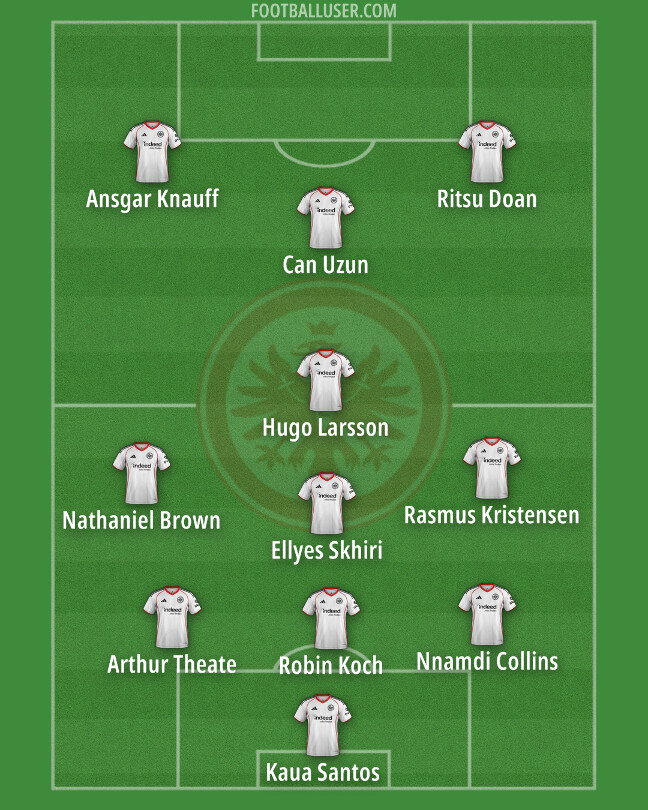
GGFN Player ratings for this travesty are already available. Much like in the league draw with Bremen, there isn’t much good news to report on an individual level. Only three players – Nathaniel Brown, Ritsu Doan, and Can Uzun – received above average (6) marks.
Schmitt and Meier went with the not terribly bad idea of deploying Uzun as a false-nine. The system worked; so much so that one didn’t really feel the need to press the panic button even after Qarabag went up 1-0 in the 4th. Uzun continued to work hard deep. Doan carved out plenty of space on the right.
The defensive constellation, aided greatly by Skhiri’s flexibility as a semi-sweeper, held well. Schmitt wasn’t totally full of it at the post match press conference when he commended his defenders for doing especially well in certain specific areas.There were some tangible signs of progress.
Uzun’s well-deserved 1-1 equalizer in the 10th could have heralded a much different result had the Germans been able to sustain the momentum. Both Uzun and Doan produced scoring chances worthy of the lead. The SGE didn’t really begin to list until after the half-hour mark.
Regrettably, the stale state of play extended well into the second 45. Schmitt waited far too long to shake the tactical constellation up. Uzun often found himself far too deep to influence play. Brown, yet again, tired out with all the running he had to do from his wingback slot.
Some ten minutes after the restart, the RheinMainAdler shifted to an ill-advised 4-3-3 that threw Uzun further back on the left (and mostly in Brown’s way). Brown didn’t have enough gas left in the tank to figure out his over/underlaps. Skhiri wasn’t his most effective in front of a tiring lone.
Götze and Chaïbi finally entered on behalf of Uzun and Doan in the 71st; a seriously questionable move considering they were the best players on the pitch and weren’t the ones demonstrating serious signs of fatigue. It almost seemed as if Schmitt wasn’t paying attention at all.
Lineup—SGE—72nd-minute (4-3-3)
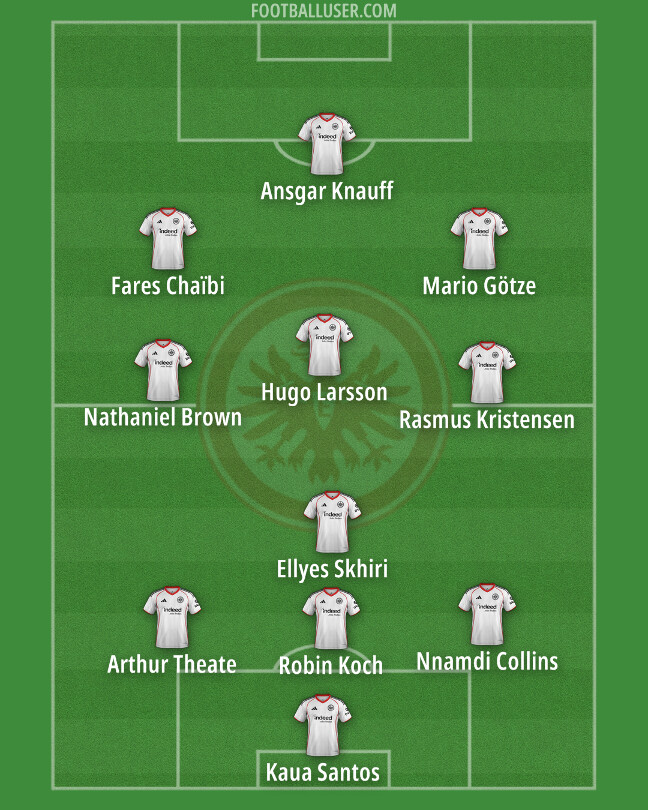
Much of went wrong for the Germans in the final stages of the game wasn’t directly related to tactics. The UCL match featured plenty of sheisty behavior from both sides as they attempted to draw penalties. Eintracht largely remained in this formation throughout, even as Jean Matteo-Bahoya (Knauff), Oscar Højlund (Larsson), and Alexander Staff (Collins) came on in relief. The personnel changes couldn’t prevent everything from falling apart.
The entire SGE left found itself culpable on the Qarabag equalizer whilst the Eintracht right fell apart on the last-minute winner. Everyone found themselves in a dour mood afterwards. As Rasmus Kristensen reflected on his own personal defensive failures whilst speaking through a pair of black eyes in the mixed zone, one felt a twinge of sympathy for him. The high late-match deployment certainly didn’t do much for his ability to defend his own box.
The “2026 Nightmare” Continues
Back in the Bundesliga, there were once again three changes to the previous XI. This time Kalimuendo, Auréle Amenda, Kalimuendo, and Chaïbi started in place of Arthur Theate, Larsson, and Knauff. Schmitt and Meier stuck with the 3-4-3 again, naturally not running the false-nine this time with their non-UCL-registered striker once again available.
Lineup—SGE—MD 19 (3-4-3)
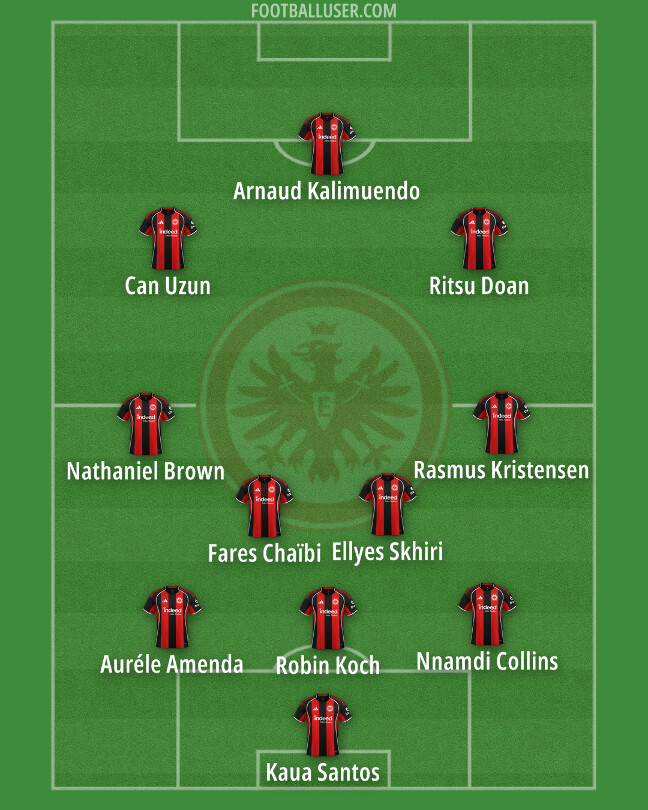
GGFN Player Ratings are also already up for the Bundesliga loss against Hoffenheim. Yet again, Doan (6) and (6) Uzun performed well. Kalimuendo – by virtue of much more than the fact that he scored a goal – actually turned in an above average day at the office. Yes, there’s some repetition here. Prepare for some more. Reality sometimes can’t help but repeat itself.
Bundesliga journalists definitely grow tired of composing pieces in which Frankfurt professionals endlessly speak about the “pattern of defensive errors” that must not be repeated. Likewise, this author knows that anyone bothering to read this might be tiring of listening to “this worked out well in the beginning”. The fact is that it simply did.
The compact defensive formation functioned precisely as intended, sparking several useful counterattacks against the vastly superior opponent. Kalimuendo’s 18th-minute opener came off one such counter. All three members of the back three, including the ordinarily problematic Amenda, hit their marks and cleared their lines exceptionally.
All throughout the opening 45, the SGE constellation looked in no danger of falling apart. The Hoffenheim set-piece playbook caused the Hessians plenty of trouble, but the Eintracht open-play game-plan clicked and hummed nicely. Only seven minutes after the restart did GGFN man of the match Max Moerstedt crack the code.
Moerstedt’s 1-1 nevertheless constituted the end of proceedings. The SGE shape wilted as Hoffenheim scored two more goals in the next 13 minutes. All of Amenda’s hard work from earlier on got more than cancelled out by his own goal that sealed the 1-3 loss in the 65th. The Waldstadion crowd gave up on their team. The team showed no hesitation in giving up on them.
“The Last UCL match”
It’s likely the case that only German footballing diehards tuned into Tottenham match this evening; a final round UCL fixture of absolutely no sporting relevance. Morbid curiosity as to what sort of crumbs of hope Riera might inherit drove a precious few of us to decline better options in favor of Spurs-SGE. And what do we have?
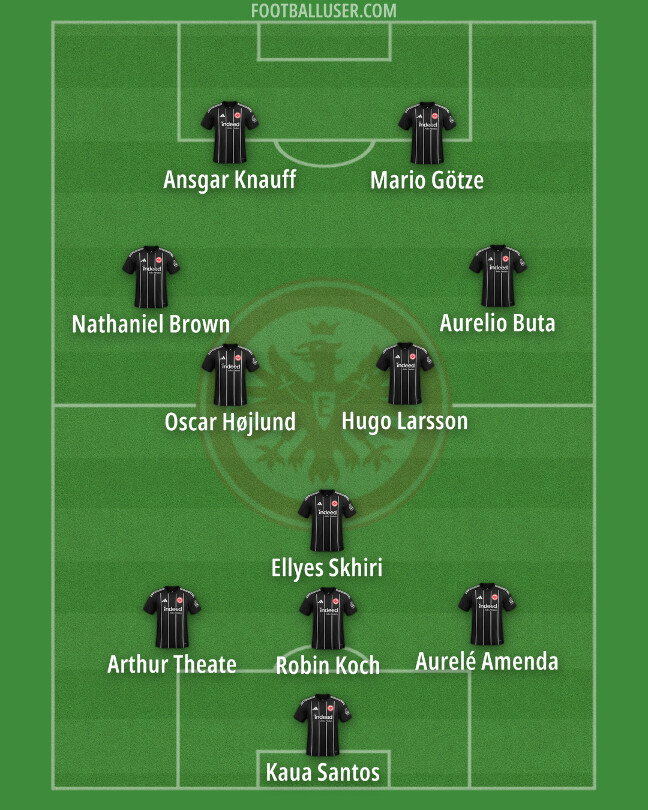
They went with a 4-4-2 this time. Six personnel changes – Aurelio Buta, Mario Götze, Theate, Højlund, Larsson, and Knauff for Collins, Kristensen, Chaïbi, Doan, Uzun, and Kalimuendo – brought us to the end of this interim regime. Schmitt literally had nothing to lose with all these rotations. Here comes the classic case of throwing something to the wall to see if it sticks.
Lineup—SGE—UCL (4-4-2)
The Waldstadion crowd really wasn’t up for this one, not even enough to boo former Bundesliga players like Xavi Simons, Kevin Danso, Joao Palhinha, and (surprisingly enough) former Frankfurt man Randal Kolo Muani whenever they touched the ball. The 58,000 strong in the Hessen venue mostly observed silently while Tottenham had their way with a bunch of replacement players ambling about at half speed.
The English guests should have taken the lead easily in the first half. A disallowed goal, a strike off the post, and a pair of missed sitters kept matters goalless until after the restart. The Londoners, via Kolo Muani, finally got a deserved lead just after the restart. Kaua Santos and some more poor finishing prevented worse. Then Dahoud (in off the bench) turned the ball into his own net.
The crowd had zero reason to engage with this one, though (just like they did after the Liverpool shellacking) gave the players some extra support after the full-time whistle. The Kurve appreciated some of the effort they saw tonight, along with the fact that the team did deliver them Champions League matches this season in the first place.
The author would also like to point out that the SGE Kurve also put up a banner thanking Dino Toppmöller at the start of the second half of the Hoffenheim match. German football fans put so much time and effort into their weekly match-day presentations. They’re also willing to forgive a bad team that still tries. Always. That’s the most important thing moving forward.
Can Riera pick up something from the above constellation?
No. Hugo Larsson created the lone attacking chance.
Let’s move on.
What does Riera have to build on?
Can Uzun’s injury basically means the new head coach has Ritsu Doan and Nathaniel Brown. That’s about it. Probably the first thing Riera (or indeed whoever the new coach happens to be) will do is to put an end to Kaua Santos second crack at the No. 1 position. Though not all goals conceded since the calendar year were Santos’ fault, the youngster has simply looked too shaky in net. Zetterer returns between the sticks for the first phase of the rebuilding process.
Learning, upon the release of the team sheet, that Mario Götze would be up front attempting to help out Knauff in a lead striker role engendered some hope in German football lovers. In the end, it proved a case of hope that shouldn’t have existed in the first place. The 33-year-old shall never come close to being the player we remembered. Apart from a third axis attacking deployment against Köln this season, our beloved gramps just hasn’t been effective at all this year.
Jonathan Burkardt will eventually return to help out the Frankfurt attack. One assumes that highly touted new January defensive signing Keita Kosugi will be available for action at some point before the season is out. When it comes to the matter of other January attacking additions such as Kalimuendo, Love Arrhov, Younes Ebnoutalib, and Ayoube Amaimouni-Echghouyab, the author has a feeling we’ll be giving the Eintracht front office a round of applause soon.
Kalimuendo, Ebnoutalib, and Amaimouni-Echghouyab have already made a big impact in the Bundesliga. The only reason the trio didn’t appear in the Champions League is because they weren’t registered for the group phase that somewhat unfairly spills over into the New Year these days. Blame that one on UEFA. Ebnoutalib’s hard luck injury also didn’t help out either Toppmöller or his successors.
Will the new coach succeed?
Much depends on whether it’s Riera or one of the two Scandinavians who ends up landing the job. To be honest, bringing in a Dane or a Norwegian made a great deal more sense than someone like Viera when one considers the international make-up of this squad. Echghouyab is the only player with Spanish roots on the roster, and the 21-year-old now speaks fluent German after five years in the Bundesrepublik.
When one thinks of successful Spanish trainers in the Bundesliga, the cases of Xabi Alonso and Pep Guardiola immediately spring to mind. Xabi, of course, already spoke excellent German thanks to his Bayern Munich stint. Moreover, Leverkusen had been trying to recruit him away from Real Sociedad B for his first major coaching assignment for a couple of years before they finally got him over in the autumn of 2022.
Xabi inherited a squad, thanks to Leverkusen’s famous Latin American recruitment efforts, full of Spanish speaking players. Guardiola, who famously spoke no German upon his Bayern appointment, also had Spanish players and was permitted to recruit more. Pep’s case was also different in that he was announced as the new Bayern head coach six-months before he actually started the job.
By the time Pep sat down for his first FCB press conference in late June 2014, a sixth-month crash course in the language had him charming the press corps in German. By the time August rolled around, Pep was hawking products in German television commercials like a pro. By the end of his first season, Pep was a pro. The man’s notorious bald head soaked it all up like a sponge, possibly due to the fact no hair follicles were there to impede progress.
Does the language barrier matter?
Nearly thirty years since Giovanni Trappatoni’s infamous press conference rant, yes it still does. Ideally, one wants one’s head coach to maintain some degree of comfort in his environment and not feel out-of-place, awkward, and pressured. One actually has reach back a very, very, very long time to think of a time in which a Bundesliga outfit hired a foreign trainer with no previous German experience.
Guessing it might be Carlo Ancelotti? No, actually. Just like with Pep, Bayern gave Ancelotti a six-month grace period to learn the language. Carlo famously didn’t put this to much good use. Roberto di Matteo? Nope. The man who took Chelsea to a Champions League title grew up speaking German in Switzerland. Louis van Gaal? Okay, that’s a tricky one. Van Gaal’s German wasn’t exactly German, but it was comprehensible.
Still thinking? Thinking English? Steve McClaren at Wolfsburg. The 2010/11 season. McClaren got thrown immediately into the fray at Germany’s green company with just over a month to prepare for German training camp. McClaren had some time to pick up the language (merging it with his Dutch) and got an awful lot of support from the German press and public.
He also had a very rough tenure that lasted only 24 matches after far too much media scrutiny.
Something very interesting and unprecedented is (perhaps) about to commence.
GGFN | Peter Weis
About Author

You may also like
-
Agent speaks on Süle’s future, Dortmund close to extending Brandt’s contract
-
Agent speaks on Süle’s future, Dortmund close to extending Brandt’s contract
-
Confirmed Women’s World Cup Qualifiers Lineups: Germany vs. Slovenia
-
DFL introduce new U-21 competition for Bundesliga and 2. Bundesliga sides starting in 2026-27
-
Uncertainty remains over Neuer’s fitness ahead of Bayern’s clash with Gladbach